USA: AMCOF
TSX-V: AMCO
GOLD: —
SILVER: —
Americore Resources is advancing the Trinity Silver Project — a district-scale silver asset in one of the most productive mining jurisdictions in the United States.
Historical resource estimates are based on a 2012 technical report and are not treated as current mineral resources by the Company. See disclaimer for details.
Trinity sits in one of Nevada’s most productive silver corridors — in the same county as Coeur Mining’s Rochester mine, which produced 15.4 million ounces of silver in 2025 following a major expansion.
Located in the Trinity Range of north-central Nevada, the project covers approximately 22,700 acres with both surface and mineral rights, and a historical silver equivalent resource of 36.1 million ounces identified from over 350 holes drilled by previous operators.
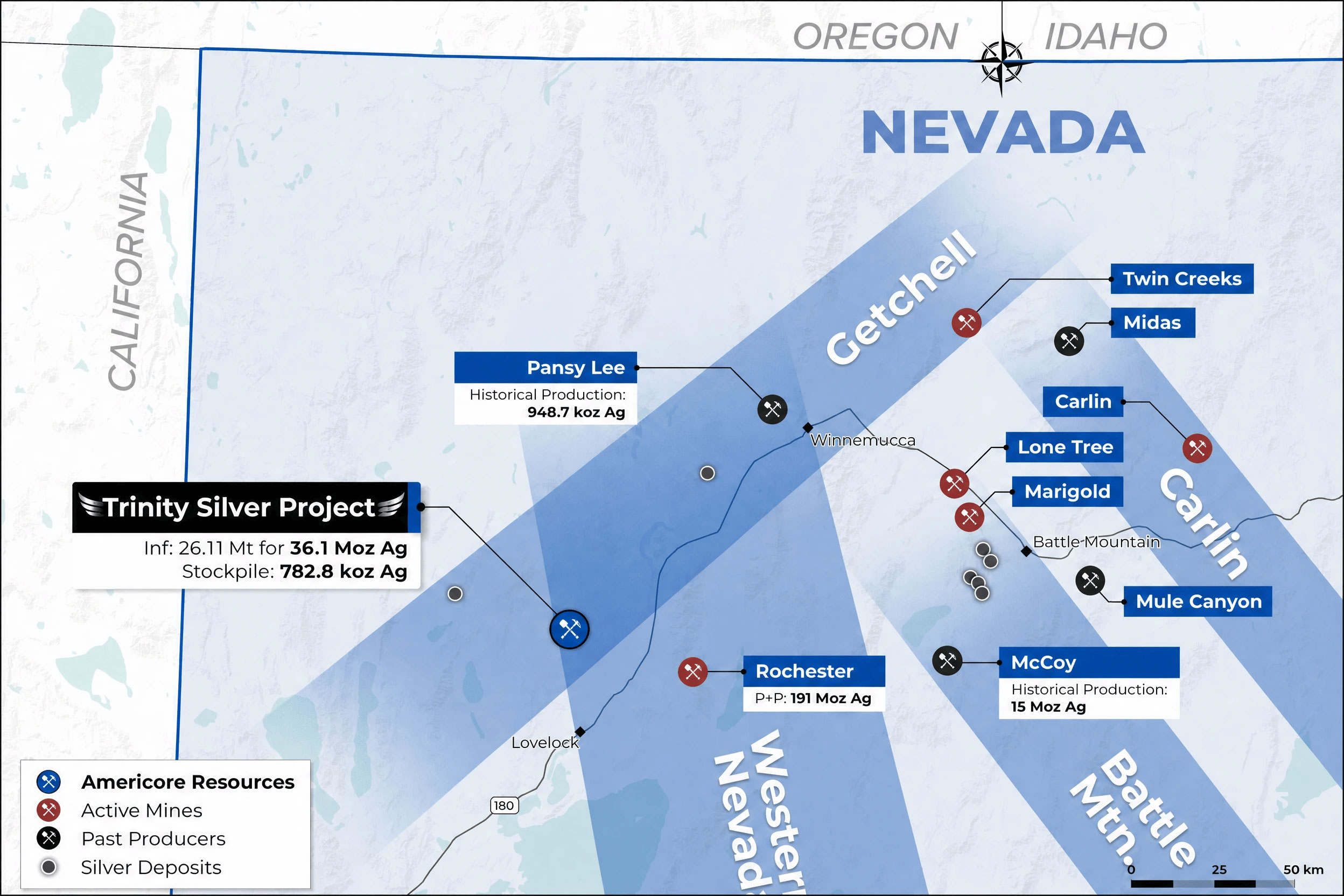
Accessible via maintained roads from Interstate 80, adjacent to the Union Pacific rail corridor
100% option on two fee simple sections (surface & mineral rights) plus 83 unpatented lode claims
Grid power and established water infrastructure in place
21-section lease position and 73 staked claims (~22,700 acres)
The position is structured with minimal upfront cash obligations and operator-friendly terms.
Results at adjacent properties are not necessarily indicative of results on the Trinity property.
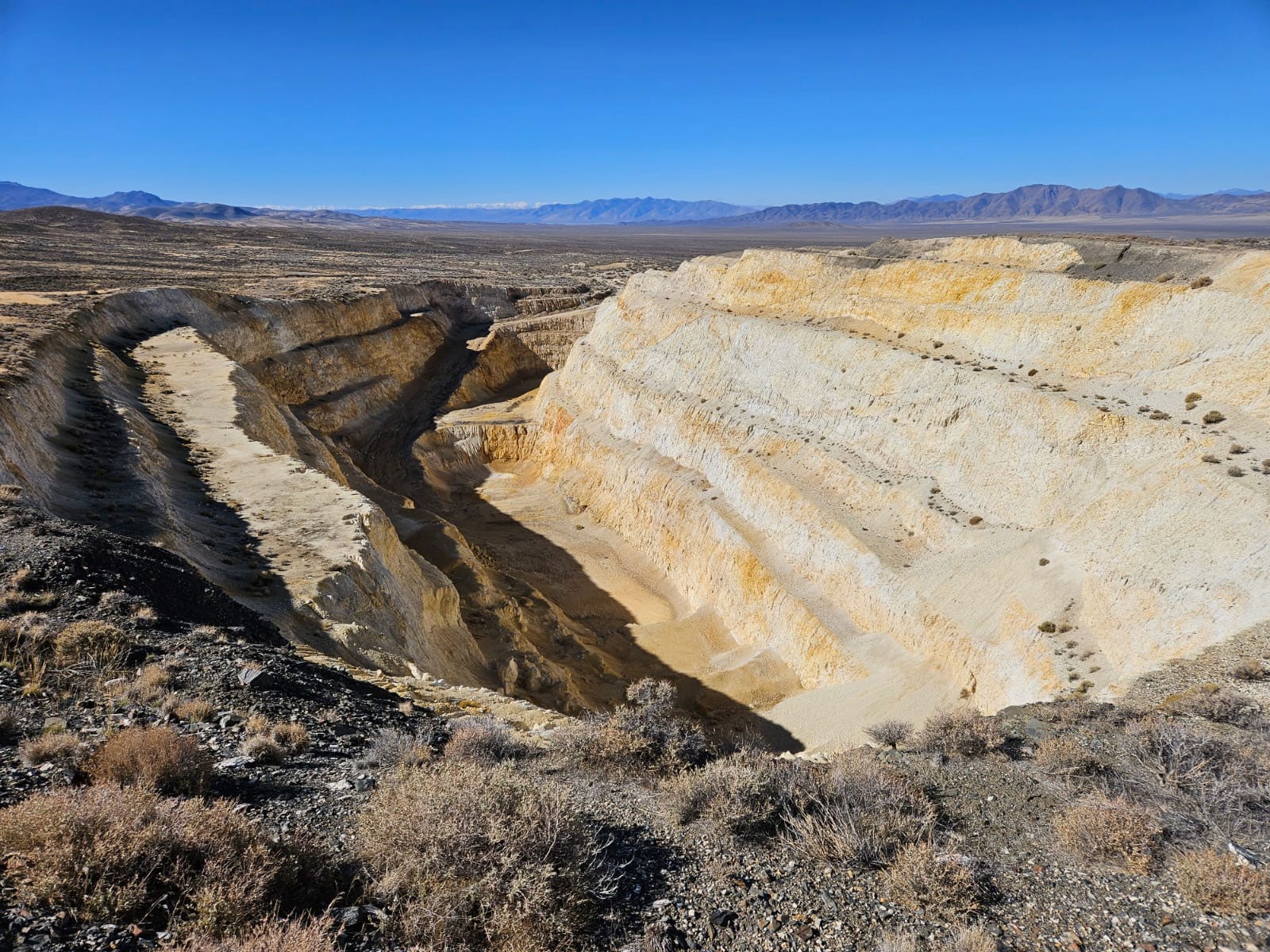
The Trinity open pit, operated by U.S. Borax 1987–1989. Existing infrastructure reduces the development timeline and capital requirements for the next phase of work.
Trinity isn’t an untested exploration target — it’s a former producing mine with a known silver system.
In the late 1980s, U.S. Borax mined over one million tons of ore here, recovering approximately five million ounces of silver through heap leach. Operations ran September 1987 to August 1988, with processing continuing into 1989.
That work targeted the shallow oxide silver near surface. Below it sits unexplored sulphide mineralization — silver with lead and zinc — that makes up the majority of the historical resource and is Americore’s primary exploration target.
Existing pit infrastructure, road access, and operational history mean a lower starting cost and shorter timeline than any greenfield project.
Trinity’s silver system remains open at depth. Many historical holes were too shallow — Hole S-133 returned 105 ft @ 390.69 g/t Ag at the bottom of the hole. Hole S-113 intercepted 260 ft @ 149.69 g/t Ag, including a 55-foot interval at 455 g/t between 265–320 ft.
A cross-section confirms mineralization extends well below the depth of all existing drilling in both oxide and sulphide zones — a significant untested target that SRK has recommended testing as part of a planned 2026–2027 drilling program.
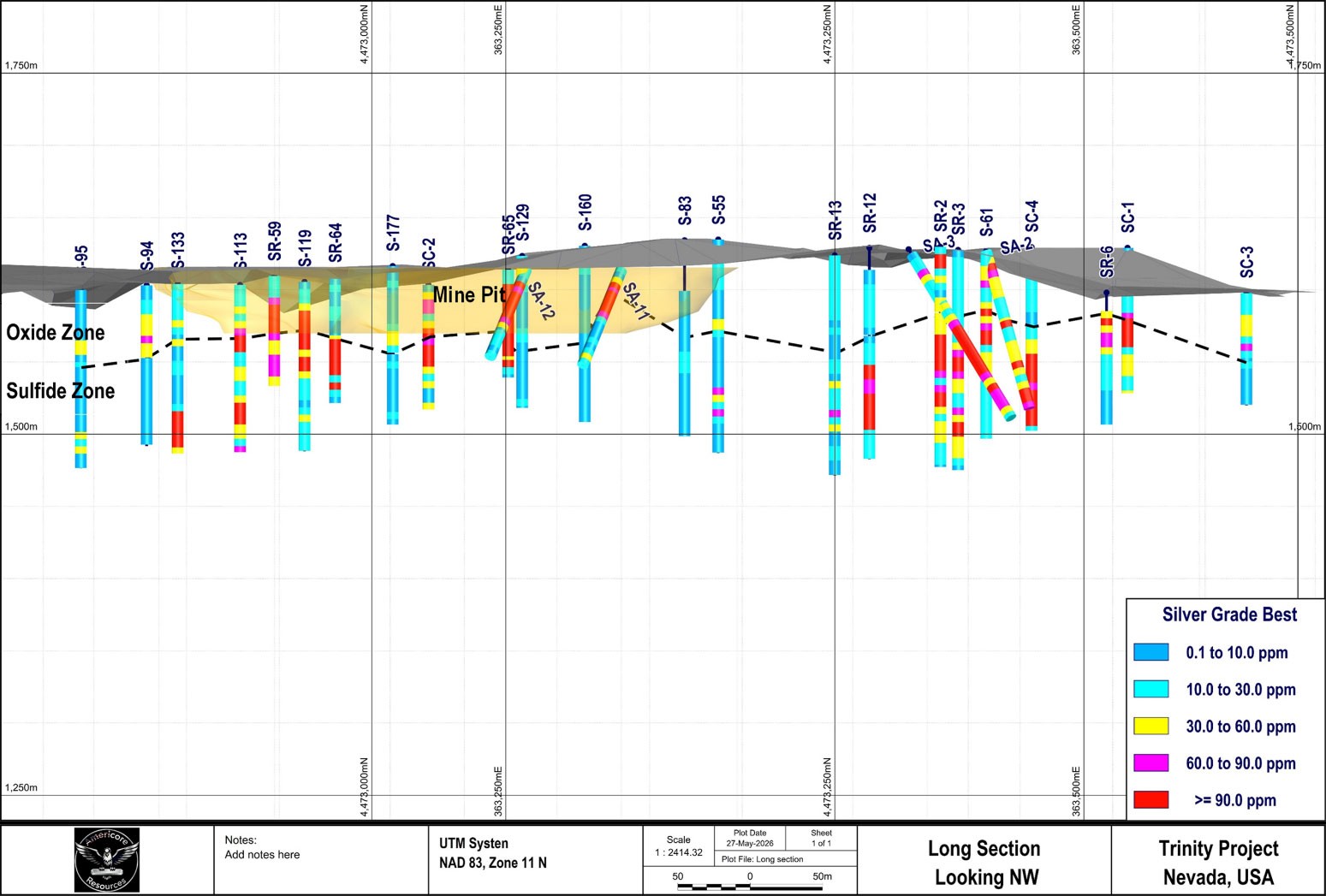
Long section looking NW — silver grade colour zonation. Circled area highlights holes that stopped in active mineralization (bottom of hole), indicating the system extends to depth.
Bottom of hole — mineralization not closed off
Bottom of hole, including 55 ft @ 455 g/t Ag (265–320 ft)
Following SRK’s June 2026 site visit, Americore is advancing a staged work program toward an updated Mineral Resource Estimate and NI 43-101 Technical Report for the Trinity Silver Project, alongside planning for a 2026–2027 drilling program.
Phase 1
Compilation and validation of historical databases and reports. Drone magnetometer (350 line-km) and hyperspectral surveys completed, identifying additional targets east and southeast of the Trinity pit. SRK completed a June 2026 site visit. Identification of material data gaps underway.
Phase 2
Updating the geological and resource models and Mineral Resource Estimate. Establishing current metal prices, recoveries, costs, and other technical assumptions. Undertaking conceptual pit optimization to demonstrate reasonable prospects for eventual economic extraction (RPEEE).
Phase 3
Preparation of an updated NI 43-101 Technical Report supporting the updated Mineral Resource Estimate.
Americore is advancing an updated Mineral Resource Estimate and NI 43-101 Technical Report, and planning a 2026–2027 drilling program.
Explore the Trinity Silver ProjectInvestor Updates
Sign up to receive updates on our latest news and events. Your email will never be shared or sold and you can opt out at any time.
We respect your privacy. Unsubscribe at any time.

Sign up to receive updates on our latest news and events. Your email will never be shared or sold and you can opt out at any time.
No, I don't want to receive updates
We'll send you updates on our latest news and events.